YouTube Shorts series give creators a more structured way to connect short videos. YouTube has announced seasons, episodes, custom thumbnails and sequential playback for Shorts series, turning separate clips into a viewing path that audiences can follow.
The opportunity is not to stretch one idea into endless parts. A useful series gives every episode an independent payoff while making the next episode feel worthwhile. This guide explains how to choose a series promise, map episodes, brief production and measure whether viewers continue watching.
What YouTube announced
YouTube’s official Shorts series announcement says creators can organise Shorts into seasons and episodes. Custom thumbnails and sequential playback are intended to help viewers discover a series and keep watching it in order.
The feature sits within a wider shift toward creator-led programming across screens. YouTube’s broader Made on YouTube 2026 overview describes tools for discovery, production and sustainable creator businesses. Availability and controls may vary by account, so confirm the current workflow in YouTube Studio before promising a launch date.
Start with a repeatable audience promise
A series needs one clear reason to return. Write the promise as: “Each episode helps this audience achieve this outcome through this repeatable format.” A software company might explain one reporting mistake per episode. A retailer might demonstrate one practical use for a product family. A consultant might answer one decision question in under a minute.
Reject concepts that depend on vague suspense, unrelated trends or a different audience every week. The subject should be broad enough for several episodes but narrow enough that viewers immediately recognise the value. Before production, search the existing channel for overlapping videos, repeated claims and unfinished series.
Build an episode map before filming
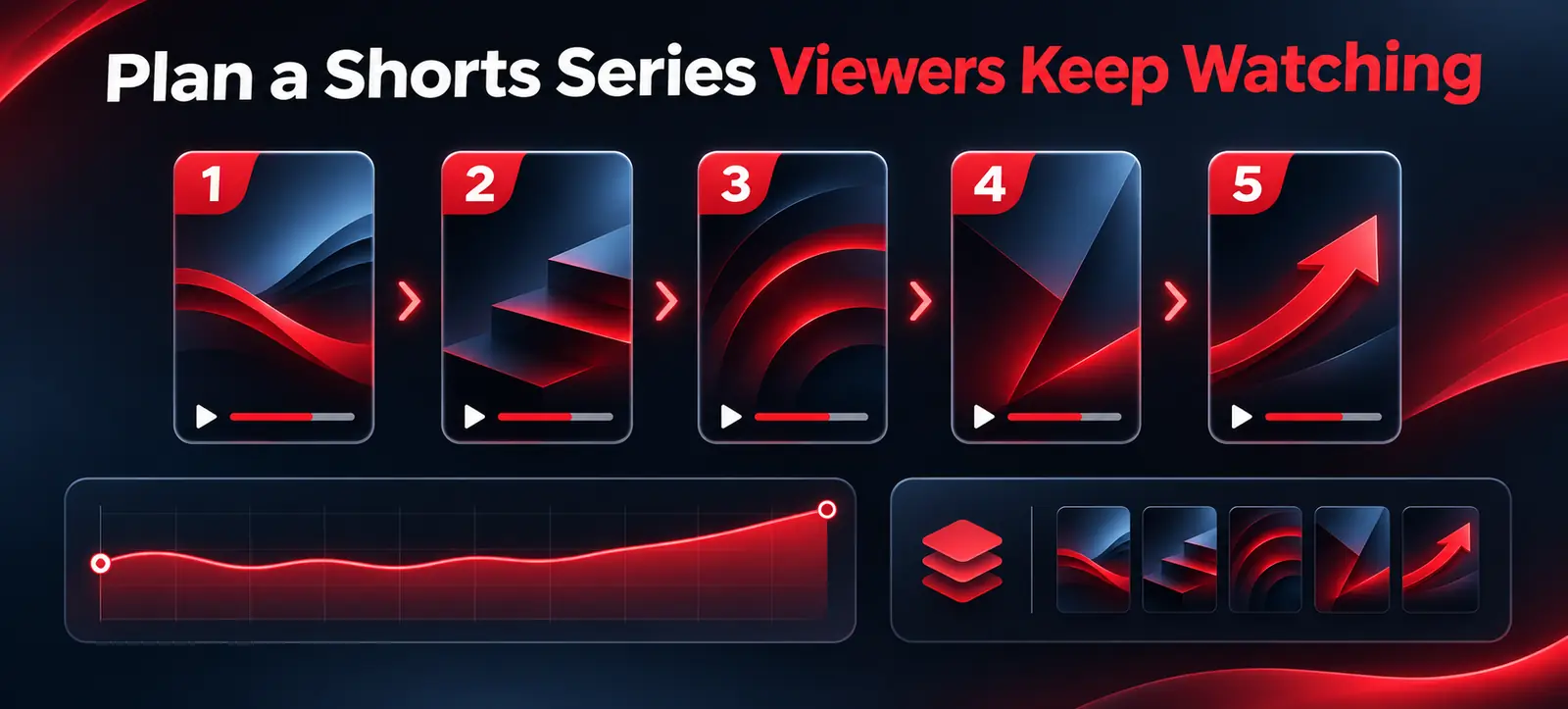
Plan a short first season of four to six episodes. Give it a logical progression: diagnose the problem, explain the options, demonstrate the process, avoid common mistakes and apply the lesson. Each episode should answer one question without requiring the viewer to watch every earlier part.
Planning field
Decision to record
Quality check
Series promise
Audience, problem and repeatable outcome
Useful without relying on hype
Episode role
Question, proof and next logical step
Standalone value plus continuity
Opening hook
Specific problem or promised result
Matched by the actual episode
Visual identity
Consistent layout, numbering and subject
Recognisable but not repetitive
Measurement
Retention, continued viewing and outcome
Compared across similar episodes
Use a shared brief with an episode number, working title, opening line, three proof points, visual demonstration, accessibility requirements and closing transition. Kayaar’s YouTube Shorts thumbnail guide explains how a consistent visual system can identify a series without making every image identical.
Make every episode independently useful
Viewers may enter on episode four, not episode one. Open with the immediate question rather than a long recap. Explain only the context needed for that clip, deliver the promised proof and use the final seconds to identify the next useful step. Avoid withholding the answer merely to force another view.
Keep calls to action proportional. “Watch the next episode for the implementation checklist” is clearer than asking for a follow, comment, share, download and sale in the same ending. If the next episode is not yet live, point to the season topic or a relevant channel resource instead of a broken promise.
Test hooks without breaking the series
Consistency does not mean repeating the same opening. Test a direct question, a visible demonstration or a surprising but supportable result while keeping the episode’s subject and proof stable. The video hook testing workflow shows why changing one creative variable at a time produces more useful evidence.
Keep brand elements light during the opening seconds. The viewer should understand the problem before seeing a long ident or animated title. Captions must be accurate, important text should stay inside safe areas, and meaning should not depend only on colour or sound.
Design for discovery and continued viewing
Use plain titles that name the problem and result. Add episode numbering as a secondary cue, not the whole title. A label such as “Episode 3” means little in search or recommendations without a descriptive subject. Keep the core topic consistent across the title, spoken opening, on-screen text and description.
Sequential playback may help order consumption, but it does not replace clear packaging. Review how thumbnails appear on mobile and larger screens, confirm the season order, and check that an episode has not been assigned twice or placed in the wrong sequence. For discovery beyond the series page, Kayaar’s Ask YouTube readiness guide explains why accurate titles and descriptions support better viewer understanding.
Measure a season, not one viral clip
Record a baseline from comparable Shorts before launch. For each episode, review the opening retention, average percentage viewed, replays, useful comments and the business action relevant to the series. Then examine movement between episodes: did viewers continue, return for the next release or visit the intended resource?
Do not declare success from raw views alone. A high-view episode may attract a broad audience that does not continue. A smaller episode may deliver stronger completion, qualified profile visits or enquiries. Compare episodes with similar length, release timing and promotion, and document any external factor that affected distribution.
After the first season, keep the strongest promise and improve the weakest stage. That may mean rewriting openings, shortening explanations, changing episode order or ending a concept that has no evidence of continued interest. If the series supports brand collaboration, define rights, disclosure and measurement before reuse; Kayaar’s creator partnership readiness guide provides that governance checklist.
Use a controlled launch checklist
Confirm that Shorts series controls are available in the channel.
Approve one audience promise and a four-to-six-episode map.
Check every claim, asset, permission, caption and link.
Publish on a realistic cadence and verify the sequence.
Review retention, continued viewing and the intended outcome.
Document the decision to continue, revise or stop the series.
A YouTube Shorts series should make useful ideas easier to follow, not manufacture empty cliffhangers. Start with one focused season, give every episode a complete payoff and scale only when the evidence shows that viewers value the sequence. For help turning channel insights into an accountable content plan, contact Kayaar.
FAQs
What is a YouTube Shorts series?
YouTube has announced a structure that lets creators organise Shorts into seasons and episodes, supported by custom thumbnails and sequential playback.
How many episodes should a first Shorts series have?
A focused pilot of four to six episodes is usually enough to test the promise, production workflow and continued viewing without overcommitting resources.
Does every episode need to work on its own?
Yes. Viewers may discover episodes out of order, so each Short should answer one clear question while pointing naturally to the next useful step.
Which metrics should a Shorts series track?
Track opening retention, average percentage viewed, replays, useful engagement, continued viewing between episodes and the business outcome defined in the brief.
Are Shorts series available to every channel?
YouTube announced the feature in September 2026, but access and controls may roll out gradually. Check the current options in YouTube Studio before planning a launch.