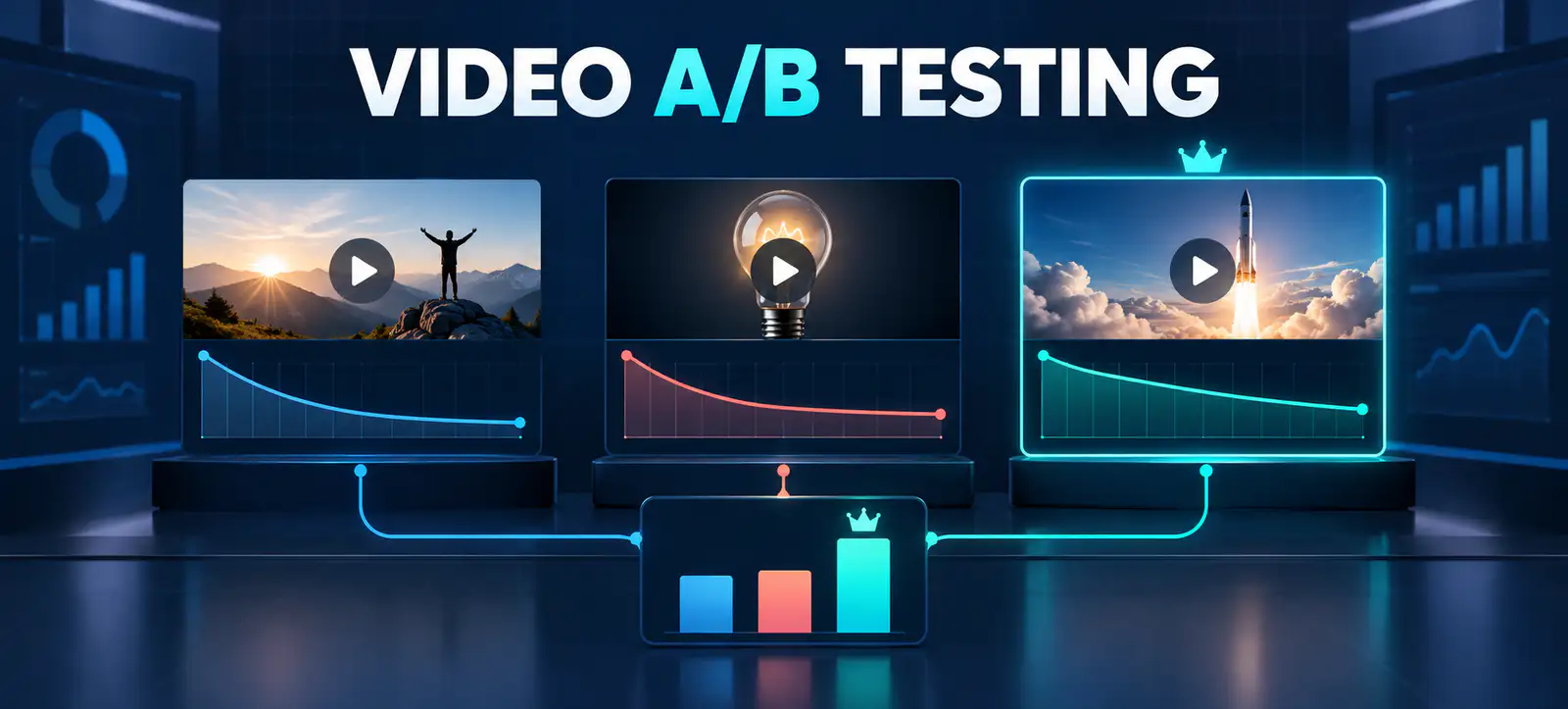
YouTube video A/B testing is expanding beyond titles and thumbnails. At Made on YouTube 2026, YouTube announced an upcoming Studio feature that will let creators compare up to three video cuts to learn which opening hook holds audience attention best.
The feature is not a reason to produce three unrelated videos or chase a single winning percentage. A useful test keeps the topic, promise and main content stable while changing one clearly defined opening. This guide shows brands and creators how to prepare a controlled hook test, review retention and protect audience trust.
What YouTube announced
YouTube’s official creator tools announcement says video A/B testing will allow up to three cuts to be tested for the hook that performs best. It is part of a wider Studio update that includes draft feedback, research tools, channel-matched thumbnails and dynamic thumbnail options.
YouTube says creators have already run more than 40 million title and thumbnail experiments since those tests launched in 2024. The broader Made on YouTube overview positions the new tools as production and publishing assistance. The video-cut feature is described as coming soon, so availability should be confirmed in each channel rather than assumed.
What should change between video cuts?
Change the opening treatment, not the underlying promise. Three cuts can use the same footage after the first section while presenting different paths into the story. One might open with the problem, another with the outcome and a third with a specific question or demonstration.
Keep the tested section short enough to isolate its role. If the versions change the topic, thumbnail, total length, offer and ending at the same time, the result cannot explain which difference influenced attention. A clean test makes the next production decision easier.
Hook approach
Opening treatment
Best suited to
Risk to review
Problem first
Show the audience frustration immediately
Tutorials and service education
The problem feels exaggerated
Outcome first
Preview the finished result before the process
Transformations and case studies
The preview reveals too much
Question first
Ask one specific audience-relevant question
Explainers and comparisons
The question is vague or generic
Proof first
Demonstrate a result, test or key fact
Product and expert content
The evidence lacks context
A practical hook-testing workflow
1. Define one decision
Write the question the test must answer. For example: “Does showing the result before the explanation improve early retention without weakening overall watch time?” Avoid broad goals such as “make the video better.” A precise decision determines which versions to create and which evidence matters.
2. Establish a stable creative brief
Lock the intended audience, topic, promise, proof, tone and action before editing the openings. Use Kayaar’s creative brief workflow to document these constants. Each hook should accurately introduce the same finished video rather than promise a different experience.
3. Design three meaningful variants
Create alternatives that are distinct enough to test but narrow enough to compare. Keep the tested duration, audio quality, captions and visual polish similar. Label the cuts by strategy—problem, outcome or proof—rather than “A,” “B” and “C” alone, so the team can reuse the learning.
4. Check the title and thumbnail promise
The opening must fulfil the expectation created before the click. Do not test a dramatic hook that conflicts with the title or cover. Kayaar’s YouTube thumbnail workflow explains how to keep visual promises accurate and readable, while allowing controlled creative variation.
5. Agree on measures before launch
Prioritise early audience retention for the hook, then check watch time, completion, relevant engagement and the video’s business objective. Public views alone are insufficient. Since YouTube changed its public view definition in August 2026, use the engaged views guide to keep exposure and continued watching separate.
6. Review the full viewing experience
A strong opening can win attention and still create a poor experience if the rest of the video delays its answer. Compare retention after the hook, viewer comments and downstream actions. Check whether the winning cut attracts the audience the content is meant to serve, not simply more initial starts.
How to interpret the result responsibly
Allow the platform enough observations to compare versions, and do not stop the test merely because one cut leads early. YouTube has not yet published complete availability and decision details for the new video-cut test, so teams should follow the instructions shown in Studio when it launches.
Document the test dates, variants, traffic context, external promotion and result. A winner is evidence for one video and audience, not a permanent rule. Repeat the underlying approach across comparable videos before turning it into a channel standard. The visible transformation principles in Kayaar’s desk setup content guide show why hook and story structure must work together.
Build a reusable testing record
Save a frame and short description of each opening before the experiment starts. Record the hypothesis, audience, topic, publication date, test window and primary measure. After the result, add what changed in early retention, where the curves converged or separated and whether comments or conversions revealed a quality difference.
Review several completed tests by hook strategy rather than collecting isolated winners. You may find that proof-first openings work for product demonstrations while problem-first openings suit educational videos. Treat that pattern as a new hypothesis, not a universal truth. Share the archive with writers, editors and channel managers so future briefs use evidence without becoming repetitive.
Common testing mistakes
Changing the title, thumbnail and video opening at the same time.
Using clickbait that the main video does not fulfil.
Comparing cuts with different audio, captions or production quality.
Declaring a winner from a small early difference.
Optimising early retention while ignoring watch time and business value.
Copying another channel’s hook without matching audience intent.
Use the tool to improve creative judgement, not replace it. A responsible test begins with a useful idea, changes one clear variable and records what the evidence can—and cannot—show. For help creating a repeatable video testing plan, share the channel and campaign objective through the Kayaar contact page.
FAQs
What is YouTube video A/B testing?
YouTube announced an upcoming Studio feature that will compare up to three video cuts to identify which opening hook performs best.
Is video A/B testing available to every channel?
YouTube described the feature as coming soon. Creators should confirm availability and current instructions inside their own YouTube Studio account.
What should change between the three cuts?
Change one defined opening approach while keeping the video’s topic, promise, main content and production quality as stable as possible.
Which metric should determine the winning hook?
Early retention is central, but review overall watch time, completion, useful engagement and the video’s intended business outcome before deciding.
Can a winning hook be reused on every video?
No. Treat it as evidence for that topic and audience, then repeat the approach across comparable videos before creating a channel-wide rule.