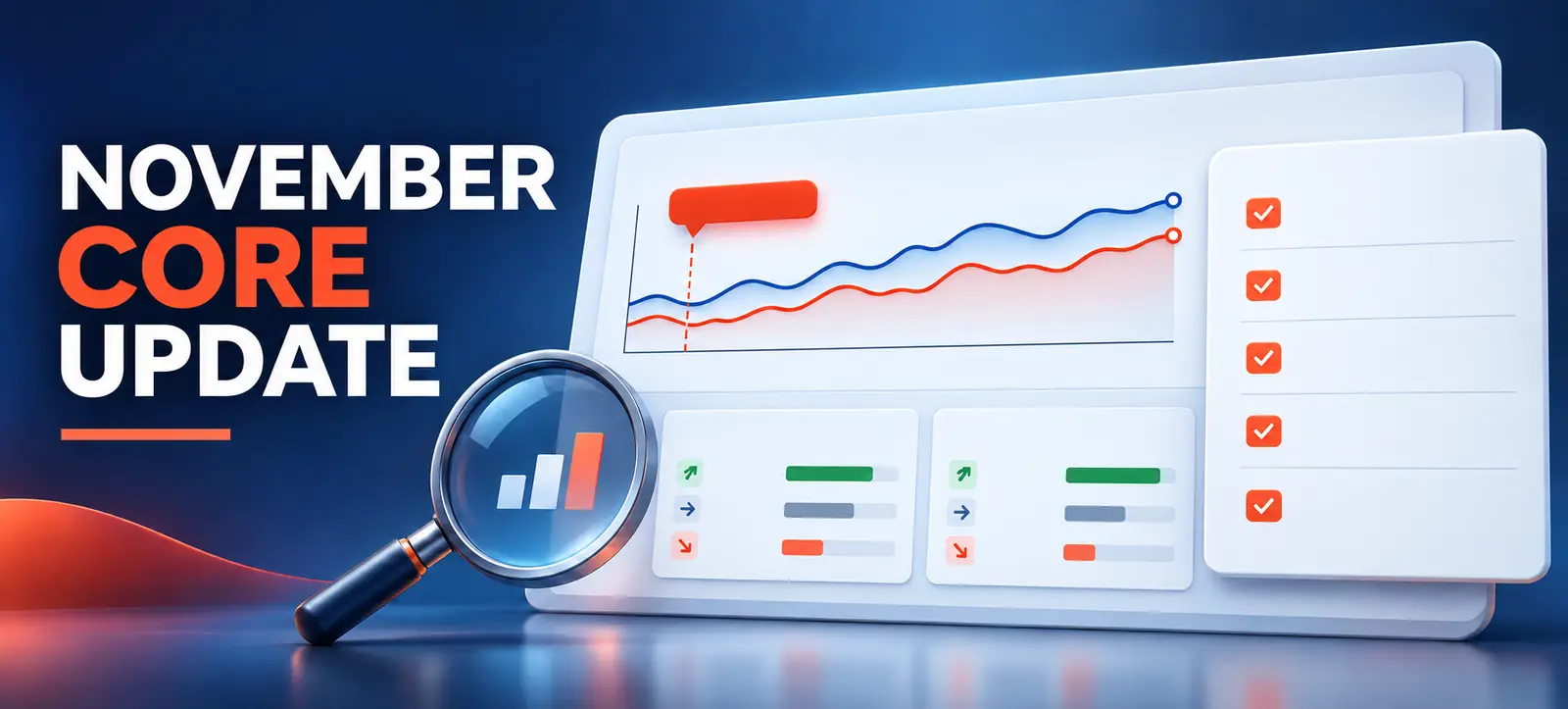
November 2026 Google core update monitoring should begin with evidence, not emergency edits. Google’s Search Status Dashboard says the update started on 10 November 2026 at 10:06 PST and remains active at the time of publication. Because rankings can fluctuate during a rollout, a short-term loss or gain is not yet a reliable verdict on a page.
The right response is to preserve a clean baseline, check for unrelated technical problems and wait for the rollout to finish before drawing conclusions. This guide provides a practical monitoring and recovery framework without claiming to know which individual ranking systems changed.
What Google has confirmed
The Google Search Status Dashboard lists the November 2026 core update as an active ranking incident. It does not describe a target industry, content format, country or specific signal. Any claim that one tactic caused the update is speculation unless Google provides additional information.
Google’s official core update guidance explains that core updates are broad changes designed to improve how helpful and reliable results are presented. They do not target one site or individual page. A page moving down is not automatically bad or penalised; other content may now be assessed as a better result.
Core updates are different from spam updates. A spam update focuses on systems that identify policy violations, while a core update broadly reassesses results. Kayaar’s September spam-update audit covers policy-focused diagnosis and should not be used as proof that a core-update decline is a spam action.
Stage
Recommended action
Avoid
Update is active
Annotate the start date, preserve data and monitor cohorts.
Rewriting many pages because of daily volatility.
First week after completion
Wait for a full week of stable post-update data.
Comparing one unusual day with a seasonal peak.
Analysis
Compare equivalent periods, pages, queries and search types.
Treating a sitewide average as a diagnosis.
Large sustained drop
Assess affected pages and sitewide quality objectively.
Searching for a single secret ranking factor.
Improvement work
Make durable, user-centred changes and document releases.
Deleting useful content or rolling back blindly.
What to do while the rollout is active
Record a baseline. Export Search Console data for the weeks before 10 November. Keep page, query, country, device and search-type dimensions where volume permits. Save analytics conversions and revenue separately so later analysis connects visibility with business impact.
Annotate known changes. List site releases, migrations, tracking changes, promotions, media campaigns and outages around the update. This prevents correlation with the rollout from being treated as proof of causation.
Check technical health. Confirm that priority URLs return successful responses, remain indexable, use intended canonicals and appear in navigation and sitemaps. Review server errors, robots rules and analytics tags. Fix a confirmed outage immediately; do not postpone genuine technical repairs because an update is running.
Monitor cohorts, not isolated keywords. Group pages by template, topic, intent, market and business value. Track branded and non-branded queries separately. Kayaar’s Search Console filter audit explains how to compare countries and devices without losing reporting context.
Keep a decision log. Record observations and proposed actions, but delay speculative content changes. If rankings recover before rollout completion, an emergency rewrite would have created an unnecessary second variable.
Separate update movement from other incidents
A core update can overlap with unrelated problems. If clicks fall while impressions and average positions remain stable, investigate tracking, consent settings, snippet changes or demand before blaming ranking systems. If impressions disappear suddenly across every query, check indexing, robots rules, canonicals and server responses.
Compare Search Console with analytics, server logs and release records. Segment by country and device to identify whether the change is global or isolated. Also check paid campaigns, brand activity and seasonal search interest. A useful diagnosis explains which pages, queries and outcomes changed; “the update caused it” is only a timing observation until competing explanations have been tested.
How to analyse results after completion
Google recommends confirming that the rollout has finished, then waiting at least one full week before analysing Search Console. Compare a complete post-update week with a complete week before the update began. Use equivalent weekdays and account for holidays, promotions and seasonal demand.
Review top pages and queries before and after the update. A small movement, such as position two to four, usually does not justify drastic action. A sustained fall from a prominent position to several result pages calls for deeper assessment. Separate Web, Images, Video and News performance because one search type can move differently from another.
Use more than rankings. Compare impressions, clicks, click-through rate, conversions and qualified outcomes. A page may lose broad informational impressions while retaining valuable leads. Conversely, stable traffic can hide a decline in commercial query quality.
Assessing a large, sustained decline
Begin with the affected cohort, then review the site as a whole. Ask whether the page fully answers the current intent, provides original evidence, explains who created it and remains easy to use. Compare it with results that improved, but do not copy their format or wording.
Check whether several pages compete for the same intent. Kayaar’s content consolidation checklist helps distinguish pages that should merge from those serving genuinely different needs. Preserve redirects, internal links and valuable sections when consolidating.
Review accuracy, sourcing, titles, descriptions, structured data and image ALT text. Kayaar’s Google generative-content guidance audit shows why production method is less important than usefulness, accuracy and added value. Do not mass-rewrite pages merely to make them appear recently updated.
Build a durable recovery plan
Prioritise fixes with clear user benefit: answer missing questions, add first-hand evidence, improve navigation, correct factual gaps and make key pages easier to understand. Assign an owner, release date and validation method to every change. Test a focused cohort before applying a template-wide revision.
Deletion should be a last resort for content that cannot be made useful. Google notes that improvements may take days or several months to be reflected, and recovery is not guaranteed. Smaller unannounced core changes can also reassess improved content between major updates.
For an independent assessment after the rollout completes, contact Kayaar with example pages, verified dates and business outcomes. Do not share Search Console access or credentials through an unsecured form.
FAQs
When did the November 2026 Google core update start?
Google’s status dashboard says it began on 10 November 2026 at 10:06 PST and was active when this article was published.
Should I change pages while the core update is active?
Avoid speculative changes during volatility, but fix confirmed technical outages, security issues or serious factual errors immediately.
When should I analyse Search Console data?
Google recommends waiting until the rollout finishes and then allowing at least one full week before comparing equivalent periods.
Does a ranking drop mean Google penalised my site?
No. Core updates broadly reassess results, and a decline does not by itself indicate a manual action or spam violation.
How long can recovery from a core update take?
Meaningful improvements may be reflected within days or take several months, and no specific recovery or ranking outcome is guaranteed.