Google’s August spam update is rolling out, bringing another reason for site owners to avoid rushing into wholesale SEO changes. A spam update is designed to improve Google’s ability to detect policy-violating behaviour. It is not a signal that every traffic change is caused by spam, and it is not an invitation to rewrite useful content overnight.
At the same time, the search industry is reporting generative interface changes in AI Overviews and a sharp fall in Reddit’s share of ChatGPT citations. These are separate observations. They may change how people encounter content, but site owners should not treat them as a confirmed cause of their own rankings or traffic movement.
What a Google spam update means
Google says it announces spam updates when it makes a meaningful improvement to its spam-detection systems. Its spam policies apply across Google Search, including generative AI responses. That means the lasting advice is unchanged: publish original, useful content; avoid deceptive tactics; and make sure your site represents a real business or author accurately.
Do not assume a decline proves a penalty. Search demand, seasonality, site releases, tracking changes, indexing issues and result-page layouts can all affect reporting. Start with evidence before choosing a remedy.
Check the right signals first
Signal
What to check
First action
Organic clicks
Which pages and queries changed on stable dates?
Compare a mature period and annotate site changes.
Indexing
Are priority URLs accessible and indexed?
Use Search Console URL Inspection before changing content.
Content quality
Does the page answer the task with original detail?
Improve gaps a reader would genuinely notice.
AI visibility
Did a layout or reporting change occur?
Keep it separate from standard organic performance.
A practical update-response workflow
Record the update date and your own releases, redirects, template changes and tracking changes.
Identify the pages with the most meaningful movement, rather than reacting to an account-level chart.
Check indexing, canonicals, page availability and internal links on those pages.
Read the page as a customer: does it add accurate, first-hand or decision-useful information?
Make a small documented improvement only where evidence supports it, then allow time to assess results.
Kayaar’s SEO audit guide provides a useful starting point for checking access, content and mobile experience before assigning blame to an update.
Generative UI in AI Overviews
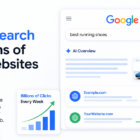
Industry reporting has highlighted evolving generative UI within AI Overviews. Google frequently tests and develops search presentation, so a change in how links, follow-up actions or sources appear can alter the visible search experience. It should not automatically be interpreted as an algorithmic ranking change.
For publishers, the practical response is to ensure important pages remain easy to scan, answer the main question early and offer a clear next step. Keep titles, headings, images and linked resources useful for people. Kayaar’s Google AI Mode content workflow and AI performance-report guide explain how to improve and measure content without chasing a single interface.
Why the Reddit citation drop needs caution
Reported changes in Reddit’s citation share within ChatGPT are a reminder that AI answer sources can shift. They do not prove that Reddit content is less useful, nor do they establish a direct relationship with Google’s spam update. Citation studies depend on the queries, markets, tools and dates sampled.
Use such reporting as a prompt to diversify evidence and improve original expertise, not to copy another platform’s content format. A business site is better served by clear services, helpful guides, current facts and internal paths that make the next action easy.
What not to do
Do not delete pages solely because traffic moved during a rollout.
Do not add artificial keywords, links or author claims to “look trustworthy.”
Do not confuse AI-overview impressions with leads or sales.
Do not use a third-party visibility chart as proof of a manual action.
Do not make many unrelated changes at once.
Review the site for spam-policy risk
A useful review asks whether the site gives people a reason to choose it beyond a keyword match. Look for pages created mainly to capture variations without adding distinct value, third-party content that has no meaningful editorial relationship to the host site, misleading redirects, copied descriptions and claims that cannot be supported. If you find a weakness, correct the customer experience first rather than trying to reverse-engineer a ranking system.
Check old pages as well as new ones. Outdated offers, expired event pages, thin location pages and abandoned campaign content can confuse visitors and make a content cluster less trustworthy. Consolidate or improve pages only when there is a clear editorial reason, and use appropriate redirects when a page has a genuine successor.
Use Search Console carefully during volatility
Search Console remains the best starting point for your own property, but recent dates can be incomplete and reports may change as data settles. Compare the same weekday pattern, separate branded from non-branded demand where possible and look at page-level evidence. A sudden decline in one query type can be a demand change; a wider decline may still require a technical check before a content response.
For generative AI reporting, interpret impressions as visibility information rather than proof of visits or commercial value. Pair any change with standard Search performance, analytics, enquiries and sales feedback. This keeps a visible interface shift from becoming a misleading business conclusion.
Build a resilient content routine
Review the pages that matter most to customers and revenue on a regular schedule, not only during announced updates. Keep factual information current, show genuine expertise, explain limitations and link naturally to related resources. Kayaar’s SEO resources, experience and contact page provide relevant next steps for readers who need support.
The August spam update and changing AI interfaces are reminders that search visibility is dynamic. Check technical health, page quality and customer usefulness first. Separate confirmed Google guidance from industry observations, then make measured improvements that help real readers.
FAQs
What is Google’s August spam update?
It is a Google update to spam-detection systems intended to improve the quality of Search results.
Should I change my website immediately?
No. Check stable data, indexing and genuine content gaps before making focused improvements.
Are AI Overview UI changes a ranking update?
Not necessarily. Search presentation changes and ranking changes should be analysed separately.
Does a Reddit citation drop prove a Google penalty?
No. Citation-share observations and Google ranking systems are different measures and should not be treated as proof of causation.
What should site owners monitor?
Monitor stable organic data, priority pages, indexing, conversions and documented site changes.