The advertising landscape is changing as businesses increasingly look beyond traditional search engines and social media platforms to reach consumers through AI-powered experiences. ChatGPT Ads is evolving in this direction with new capabilities focused on conversion optimization, measurement and product discovery.
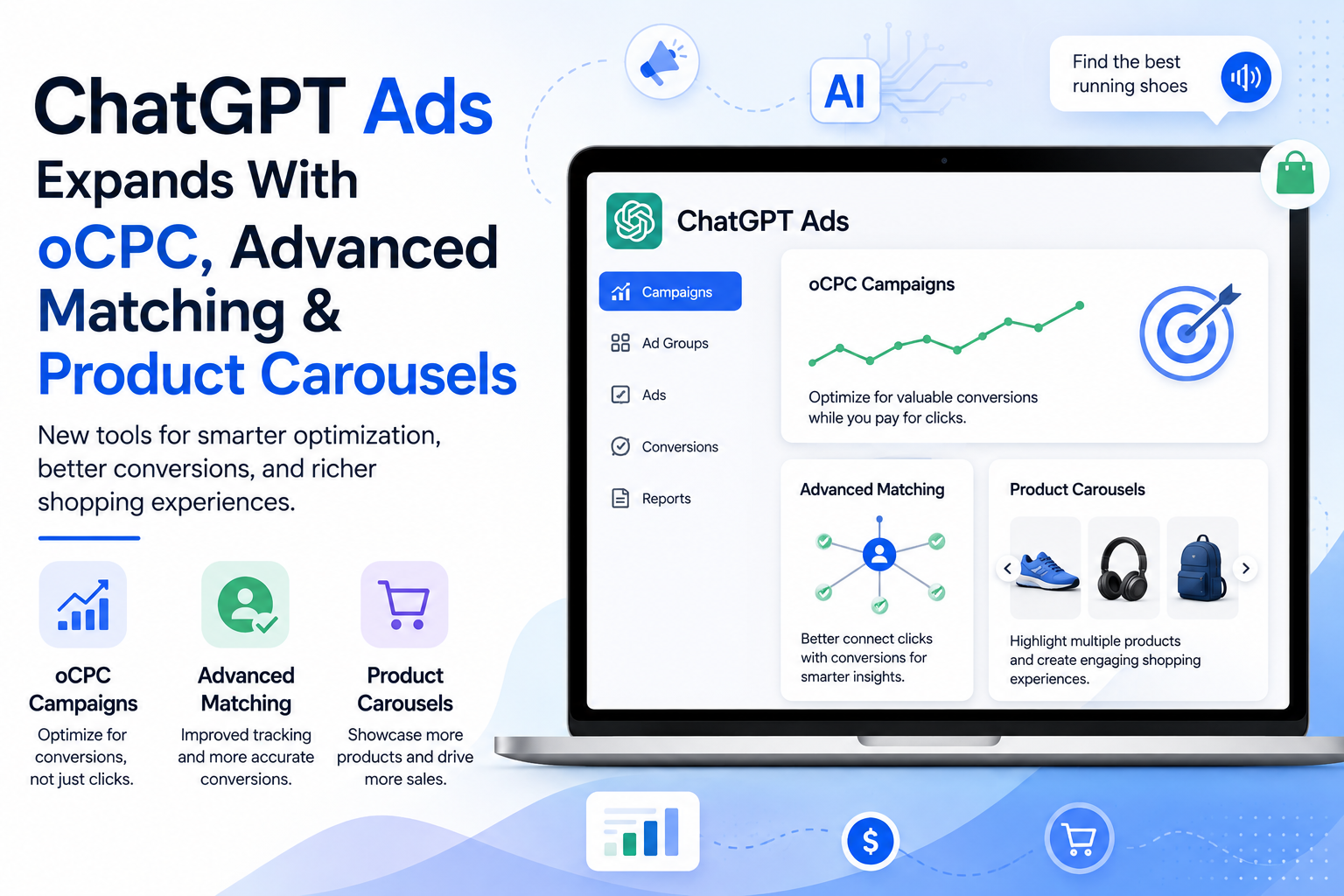
Among the latest developments are conversion-optimized cost-per-click (oCPC) campaigns, improved conversion matching capabilities and product-focused advertising options. These additions give advertisers more tools to connect their campaigns with measurable business outcomes.
The updates also highlight a broader shift toward AI-native advertising, where conversational context and user intent can play an important role in determining when an advertisement is relevant.
What Is ChatGPT Ads?
ChatGPT Ads is OpenAI’s advertising platform that allows businesses to reach users while they explore options, compare products and services, and make purchasing decisions within ChatGPT.
Unlike traditional keyword-based advertising, ChatGPT’s advertising system can consider the context and intent of a conversation when determining which ads may be relevant. Advertisers can also provide contextual hints to help describe the types of conversations where their products or services may be useful.
This creates a different approach to digital advertising one that is built around conversation, context and user intent rather than keywords alone.
What Is oCPC in ChatGPT Ads?
One of the most important new additions is conversion-optimized cost-per-click, or oCPC.
With traditional CPC advertising, advertisers pay when someone clicks an advertisement. oCPC takes this a step further by optimizing ad delivery toward clicks that are more likely to result in a specific conversion.
The advertiser still pays for valid clicks not completed conversions. However, the system attempts to find users who are more likely to complete the selected conversion action after clicking the advertisement.
Supported conversion goals can include actions such as:
Purchases
Sign-ups
Lead submissions
Other supported standard conversion events
For businesses focused on measurable results, this can make ChatGPT Ads more attractive than campaigns designed solely to generate website traffic.
How ChatGPT oCPC Campaigns Work
Advertisers creating an oCPC campaign select the Conversions objective in Ads Manager.
They then choose the conversion event they want the campaign to optimize toward.
Before launching the campaign, advertisers need conversion tracking configured through supported methods such as the Conversions API or JavaScript Pixel.
Advertisers can also set a Bid Cap, which represents the maximum amount they are willing to pay for a click in an auction. The actual CPC can be lower than this maximum depending on the auction.
This approach gives marketers greater control while allowing the advertising system to focus on clicks that are more closely connected to their business objectives.
Advanced Matching Can Improve Conversion Measurement
Another important development is the expansion of advanced matching capabilities.
Accurate conversion measurement is essential for performance marketing. Advertisers need to understand whether clicks and interactions are actually contributing to leads, purchases or other valuable actions.
Improved matching and conversion measurement can provide advertisers with better data for evaluating campaign performance and making optimization decisions.
For businesses investing in AI advertising, reliable measurement will become increasingly important as campaigns become more sophisticated.
Product Advertising Opens New Opportunities for Ecommerce
ChatGPT is also expanding its advertising capabilities for businesses that sell products online.
Product-focused advertising can help ecommerce brands showcase relevant products while consumers are researching options and comparing alternatives.
OpenAI’s current advertising infrastructure also supports product-feed campaigns, allowing retail advertisers to upload product catalogs and create ads at scale. Product feeds can help keep product information, availability, images and landing pages connected to advertising campaigns.
This could become particularly valuable for retailers with large or frequently changing inventories.
Why These ChatGPT Ads Updates Matter
The latest developments address three major priorities for digital advertisers:
1. Conversion Optimization
oCPC gives advertisers an option designed around downstream conversion events rather than clicks alone.
2. Better Measurement
Improved conversion tracking and matching can help businesses understand campaign performance more effectively.
3. Product Discovery
Product advertising creates new opportunities for ecommerce businesses to reach consumers while they are actively researching and comparing products.
Together, these features move ChatGPT Ads further toward a performance-oriented advertising platform.
ChatGPT Ads vs Traditional Digital Advertising
Traditional advertising platforms often rely heavily on keywords, audiences or predefined targeting categories.
ChatGPT advertising introduces another layer: conversation context.
A person might not search for a specific product using a conventional keyword. Instead, they may describe a problem, explain what they need, compare several options or ask for recommendations.
That conversation can provide richer signals about the user’s intent.
OpenAI says its advertising system considers signals such as the current conversation context, ad landing page, title, copy and advertiser-provided context hints when determining ad relevance.
For marketers, this means advertising strategies may need to evolve beyond traditional keyword targeting.
What Advertisers Should Do Next
Businesses considering ChatGPT Ads should focus on building campaigns around clear business objectives.
Define the Conversion Goal
Before launching an oCPC campaign, determine whether the primary goal is a purchase, lead, registration or another supported conversion event.
Set Up Conversion Tracking
Accurate tracking is essential because oCPC relies on conversion signals for optimization.
Create Multiple Ad Variations
Instead of relying on one headline and message, advertisers can test different value propositions and creative approaches.
OpenAI recommends using diverse ad variations so the system has more opportunities to identify relevant situations for an advertiser’s offering.
Use Relevant Landing Pages
Send users to the most relevant product, service or content page rather than automatically directing every visitor to the homepage.
Monitor More Than Clicks
For conversion-focused campaigns, marketers should pay close attention to:
Conversion volume
Cost per conversion
Click-through rate
Average CPC
Overall spend
Conversion rate
This provides a much clearer picture of campaign effectiveness than clicks alone.
The Rise of AI-Native Advertising
The expansion of ChatGPT Ads reflects a larger change taking place across digital marketing.
Consumers are increasingly using AI tools to research products, compare services, solve problems and make decisions. This creates a new environment in which advertising can become part of the discovery process rather than simply appearing alongside a search result.
For advertisers, the opportunity is significant but success will depend on relevance.
Ads need to provide a clear benefit, match the user’s needs and lead to a useful landing-page experience. OpenAI’s advertising guidance specifically emphasizes clear, specific and benefit-focused messaging.
Final Thoughts
The introduction of oCPC campaigns, advanced conversion capabilities and product-focused advertising represents an important development for ChatGPT Ads.
For performance marketers, the biggest opportunity is the ability to combine AI-driven contextual relevance with conversion optimization and improved measurement.
Ecommerce brands may also benefit as product advertising becomes a larger part of the AI shopping experience.
As consumers continue using conversational AI to research and make purchasing decisions, businesses that learn how to create useful, relevant and measurable advertising experiences could gain an advantage in this emerging channel.
The future of digital advertising may not be based only on what users search for it may increasingly depend on what they are trying to accomplish